
A 1‑of‑1 tablet experience that makes prospects stop, press, and say “you have to see this.”
Instead of sending another PDF or link that gets saved “for later,” this concept turns the pitch itself
into a physical, Kre8‑branded experience your prospect can’t ignore — and doesn’t want to put down.
Below is a quick walkthrough of the experience from your prospect’s point of view, with visuals to match.
* I use the product tagline “The Pitch that Powers On” in the demo. In production, it would be the tagline for the customized presentation.
Prospects are conditioned to say, “Just send me something.”
What they really mean is: “Send me something I can ignore later.”
Our idea: instead of sending another thing to “read later,” send an experience they want to interact
with right now.
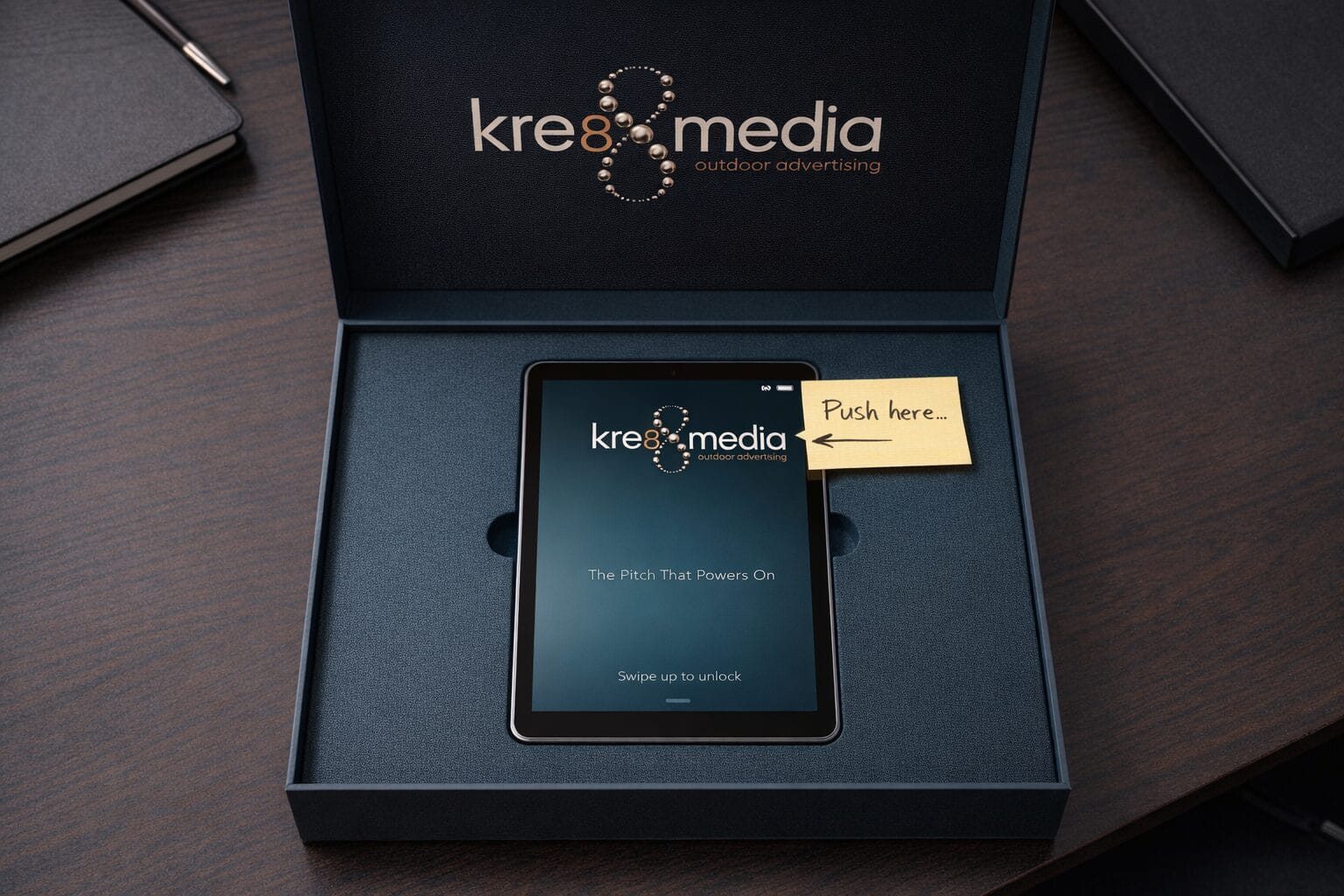
Our prospect doesn’t get an email. He gets a box.
Heavy. Premium. Personal. Inside: a custom Kre8‑branded Windows tablet, nested in dark teal padding.
On the inside of the lid: the Kre8 Media logo.
On the tablet glass, a handwritten sticky note:
It’s simple, almost playful — but it does what no subject line can: it makes him want to press the button.
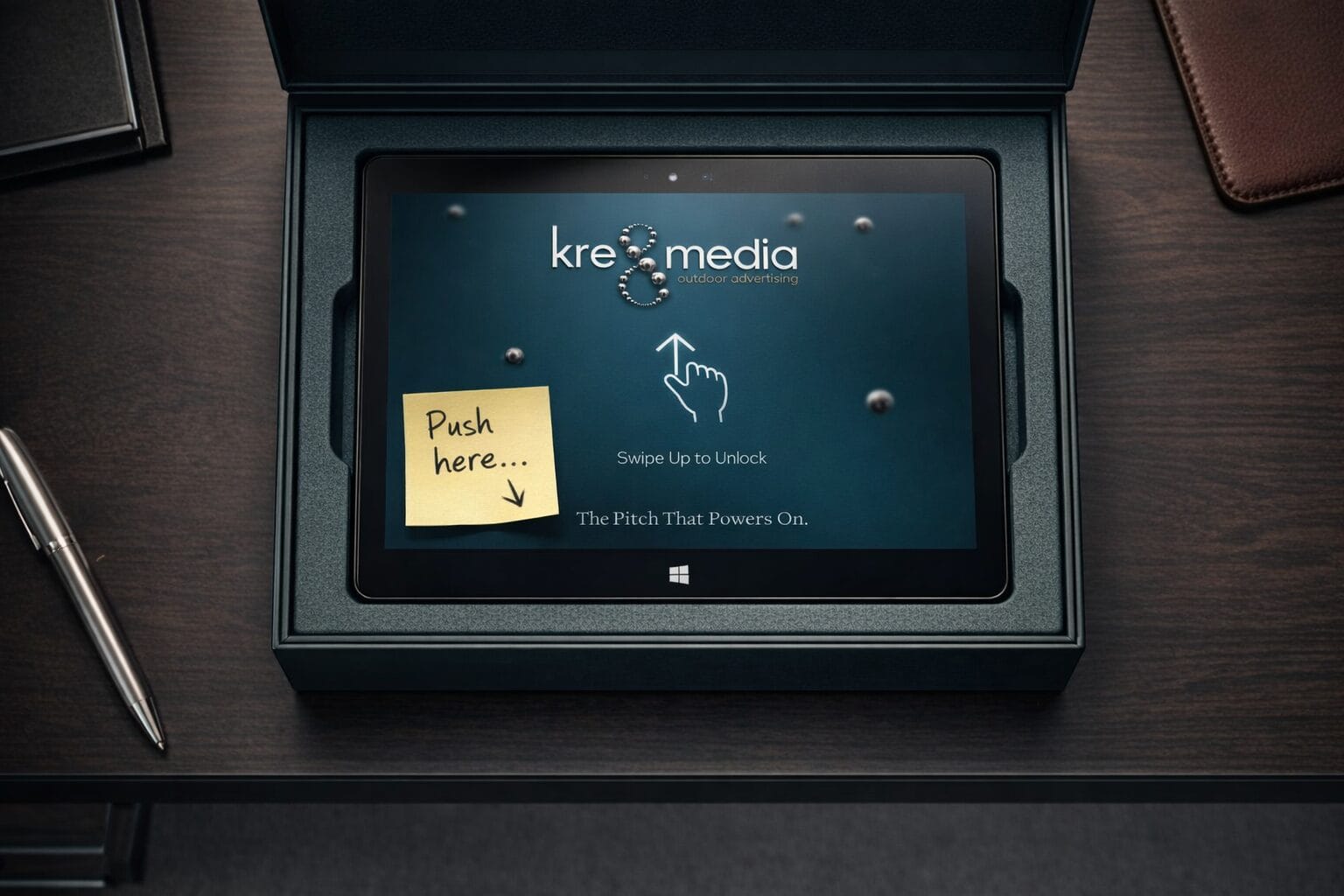
The tablet doesn’t boot into a cluttered Windows interface. It wakes into our world.
No icons. No menus. No friction. Just one obvious, irresistible next step.
He swipes.
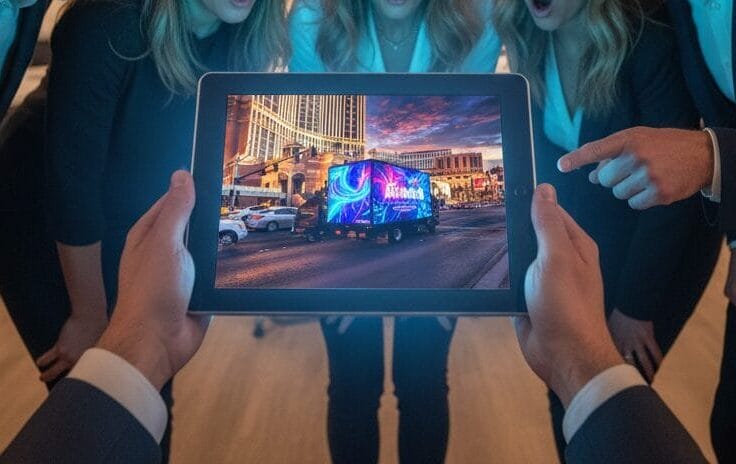
Instead of clicking through slides, he scrolls through a cinematic one‑page story:
The page connects what he’s seeing on the tablet to what Kre8 does on the streets of Las Vegas:
giant, unforgettable digital moments — now shrunk down into a 1‑of‑1, on‑the‑desk version.
At the bottom, he hits the call to action.
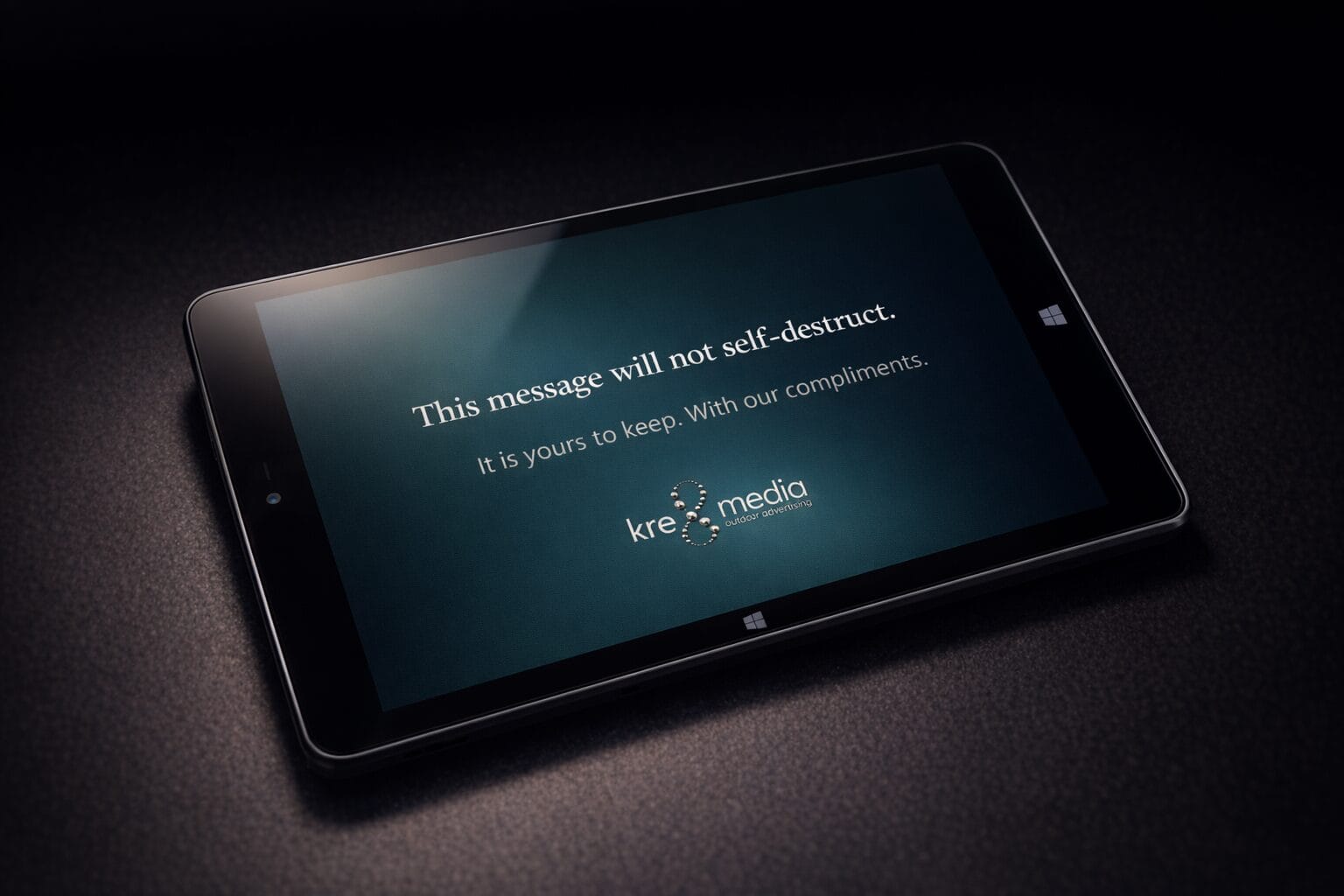
The screen settles into a final, simple frame. No hard sell — just a line that sticks:
It closes the story with quiet confidence: we’re not chasing him — we’re inviting him.
Then the tablet transitions to a clean, Kre8‑themed Windows environment with one main tile:
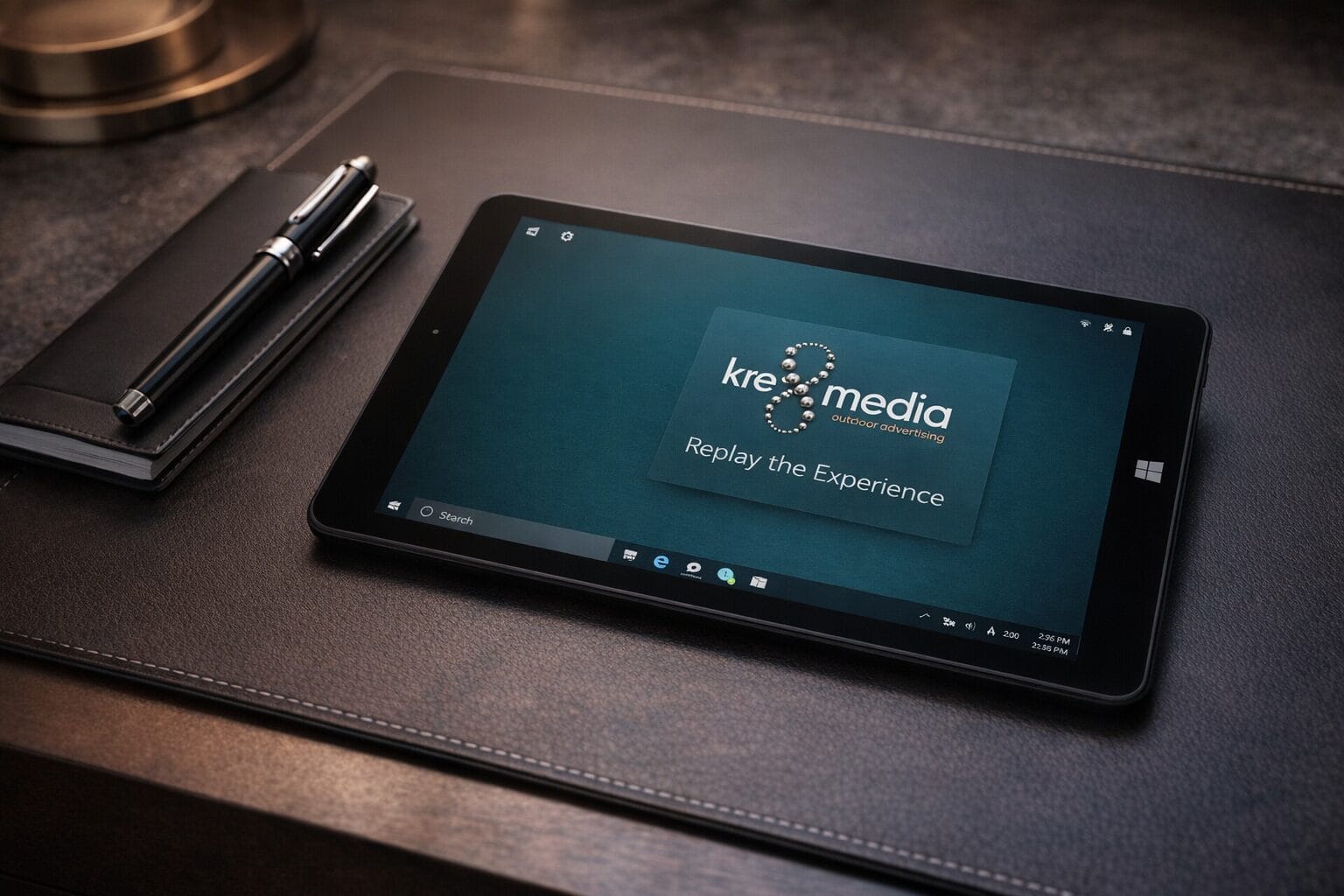
Here’s where it becomes more than a one‑time pitch.
He doesn’t throw the tablet in a drawer.
He walks out of his office with it:
A small crowd forms. He taps Replay the Experience.
Now Kre8 isn’t just being read — it’s being talked about:
The tablet becomes a conversation piece that lives on his desk.
Every time someone asks about it, the story runs again.

Kre8 isn’t in the brochure business. Kre8 is in the spectacle business:
This tablet experience is the desk‑sized version of what Kre8 already does:
hard to ignore, visually dominant, and worth talking about.
While everyone else is sending 1 of 2,000 emails, this is 1 of 1 – a physical,
cinematic artifact built just for that prospect.
If you want to feel it the way the prospect will, here’s the long‑form walkthrough in one continuous flow:
He’s at his desk, half in the day, half out of it—one eye on the clock, one eye on the next interruption. His assistant drops a box on the corner of his desk.
Not a FedEx envelope. Not a padded mailer. Not a “please read our brochure” packet that looks like effort. A real box. Heavy enough to feel intentional. Clean. Premium. Minimal. The kind of packaging that quietly says: someone spent money on this… for me.
He turns it once, then again, reading the label. His name is there. Spelled right. No “Dear Sir/Madam.” No mass-mail energy. It feels like the opposite of “spray and pray.” Curiosity does what no subject line ever could.
He opens it.
Inside: a tablet. But not a random device tossed in foam. This looks… curated. Branded. Designed. Like a Microsoft product that somehow got reimagined by someone who understands how high-end things are supposed to feel. Co-branded in a way that makes it look official—like this device belongs to a campaign, a mission, an experience.
And then he notices it. A sticky note. Handwritten. Not printed. Not a fake handwriting font. Just a small square of paper with a simple instruction: “Push here…” A little arrow points to the wake button.
He smirks—almost annoyed at how effective that is—because he knows what he’s been conditioned to ignore. PDFs. Decks. Links. Attachments. “When you get a minute.” All the things that turn into never.
But this? This is already different. It doesn’t feel like work. It feels like a dare.
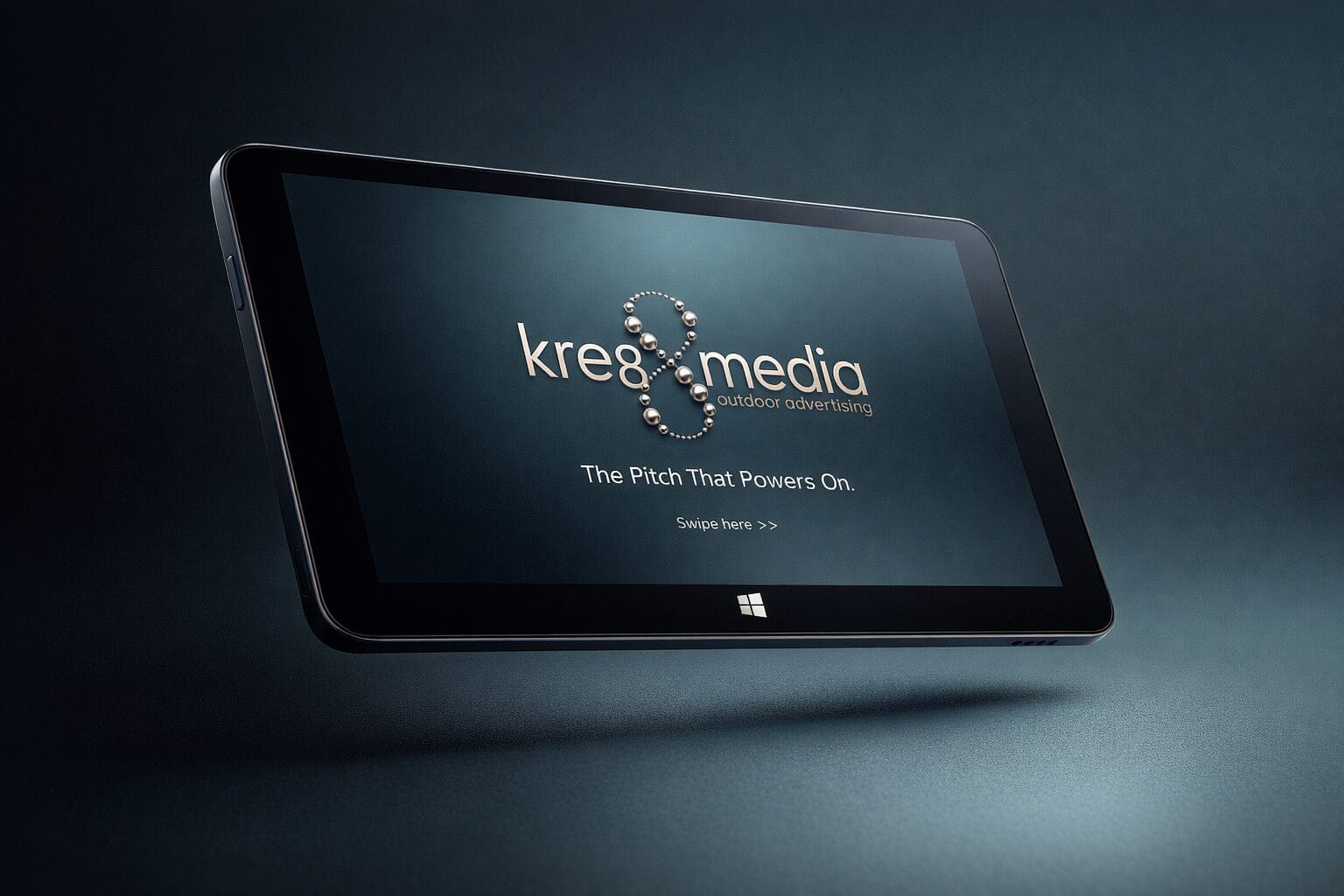
He presses the button. The screen wakes. Not into a cluttered Windows desktop. Not into the default chaos that immediately makes you feel like you’re about to troubleshoot something. It wakes into a lock screen that’s gorgeous—simple, cinematic, perfectly branded. A teaser line sits there like a movie trailer: “The Pitch That Powers On.”
Below it: one instruction. “Swipe here >>”
He swipes. And the moment he does, the “pitch deck” problem dies. There’s no file to open. No PowerPoint to download. No PDF to squint at. No mental tax of “I’ll skim this now and actually read it later.”
The experience begins immediately—like stepping into a story already in motion. It’s a single, scrollable presentation. Clean. Smooth. Designed like a high-end product launch page and a cinematic trailer had a baby. It moves at his pace, not the presenter’s. He can stop. Re-read. Skip. Go back. But it’s so well composed that he doesn’t want to.
A bold statement. A striking image. A short line that answers the exact question he’s about to ask. He scrolls. More proof. More intrigue. More clarity. Not “features and benefits” piled like laundry—this feels like someone wrote it specifically for the way his mind works when he’s deciding whether something matters.
He realizes something, almost unconsciously: He’s not skimming. He’s actually reading.
Because it isn’t asking him to do work. It’s giving him an experience. It’s making the story feel effortless. He scrolls again. Now it’s not just “what it is”—it’s why it matters to him. The tone is confident, restrained, premium. No desperate selling. No corporate filler. Every section feels like it’s there for a reason. Every line feels like it was written to be remembered.
He keeps going. There’s a call to action near the end—but it doesn’t feel like a sales trap. It feels like the natural next move. Like the final step in a sequence that’s been engineered. He clicks.
And then the last moment hits.
The screen goes dark for a beat, then a message appears—clean, quiet, unmistakably intentional. It feels like the end of a spy film, or the last frame of a trailer that refuses to leave your head. A line you can hear in your mind like a voiceover:
“THIS MESSAGE WILL NOT SELF-DESTRUCT.”
IT IS YOURS TO KEEP. WITH OUR COMPLIMENTS.
He pauses. Because that line doesn’t just close a presentation—it seals a feeling. A feeling that what he just experienced was exclusive. Crafted. Almost secret. Like he was chosen.
And then something even smarter happens: Instead of dumping him into the usual Windows mess, the tablet transitions into a clean environment—de-bloated, simplified, optimized. The kind of interface that feels like a “hacker cleaned it up,” but with the polish of a luxury brand.
There’s almost nothing to distract him. Just a desktop with one obvious icon: “Click here to relive the experience.”
He sits back. And the part nobody talks about—the part that kills traditional decks—doesn’t happen. He doesn’t close it and toss it onto a pile. He doesn’t think, “I’ll circle back when I have time.” Because there’s nothing to “circle back” to. He already had the moment. He already felt the thing.
He picks it up again. Not because he has to—because he wants to. He turns the tablet slightly, studies it like a premium object. It looks good on his desk. It looks important. And even if he’s not 100% sold on the offer yet, he’s now 100% aware of one fact: Whoever sent this is not playing the same game as everyone else.
He stands up. And this is where the magic multiplies.
He walks out of his office with it. He finds someone—an assistant, a colleague, a partner—and says the line that never happens with a PDF: “You have to see this.”
They gather. He taps the icon. The experience resets instantly—like it was designed for exactly this. It starts clean, right from the beginning, every time. The lock screen appears again. The swipe. The opening moment.
And now it’s not just him reading. It’s them watching him watch it. It’s social proof in real time. It’s curiosity becoming contagious. Someone leans in: “Wait—what is that?” Someone else: “Who sent you that?” Another: “That’s insane. That’s a pitch deck?” Someone laughs: “Why can’t everyone do this?”
A small crowd forms, almost by accident—because this isn’t a document. It’s a thing worth seeing. And as they watch, the brand does its real work: Not just transmitting information. Creating a story.
Now the message isn’t locked inside his inbox. It’s out loud. It’s in a hallway conversation. It’s in the tone of “WTF is this?” It’s in the social energy of “show me again.”
And then—because the device is physical, premium, and feels like it belongs—it earns a place. Back on his desk. Not in his trash. Not in his Downloads folder. On the desk. A conversation piece. A quiet, high-status object that keeps doing what no PDF can do: generating repeated moments. Over and over. Every time someone notices it. Every time someone asks. Every time he hits replay.
And that’s the real shift. You didn’t send him a deck. You sent him an experience that turns attention into momentum—without requiring a meeting, without requiring him to “make time,” without requiring him to be in the mood to care.
You bypassed the conditioned reflex people have to endure pitches. You made them want to press the button.
THE PITCH THAT POWERS ON.