Every business says it wants to scale.
Most quietly sabotage that goal by piling on complexity they mistake for sophistication.
Complexity Feels Like Progress
— Until It Breaks You
Complexity gives the illusion of momentum.
More systems.
More tools.
More dashboards.
More meetings.
More rules.
More people explaining things instead of doing them.
It feels like growth because something is always happening.
But here’s the part no one wants to say out loud:
Complexity doesn’t scale. It multiplies friction.
Every new layer adds drag. Every new process slows decisions. Every new dependency introduces failure points.
You don’t scale by stacking. You scale by stripping.

Simple Systems Move Faster — Because They Don’t Need Permission
Simple businesses don’t require constant explanation.
They:
- know exactly what they do
- know who it’s for
- know what matters
- know what to ignore
Decisions get made without committees. Execution doesn’t wait on consensus. Progress doesn’t stall while someone “circles back.”
Simplicity compresses distance between idea and action.
That compression is speed. Speed is leverage. Leverage is scale.
Complexity Is a Tax You Pay Forever
Every layer you add today becomes a cost you carry tomorrow.
- requires more explanation
- demands more coordination
- creates more handoffs
- produces more errors
And worst of all — it hides responsibility.
When something breaks in a complex organization, no one owns it. When something breaks in a simple one, it’s obvious where the fix lives.
Scaling Isn’t About Adding — It’s About Removing Resistance
Most people think scaling means:
- adding more staff
- adding more automation
- adding more features
- adding more process
That’s not scaling. That’s inflation.
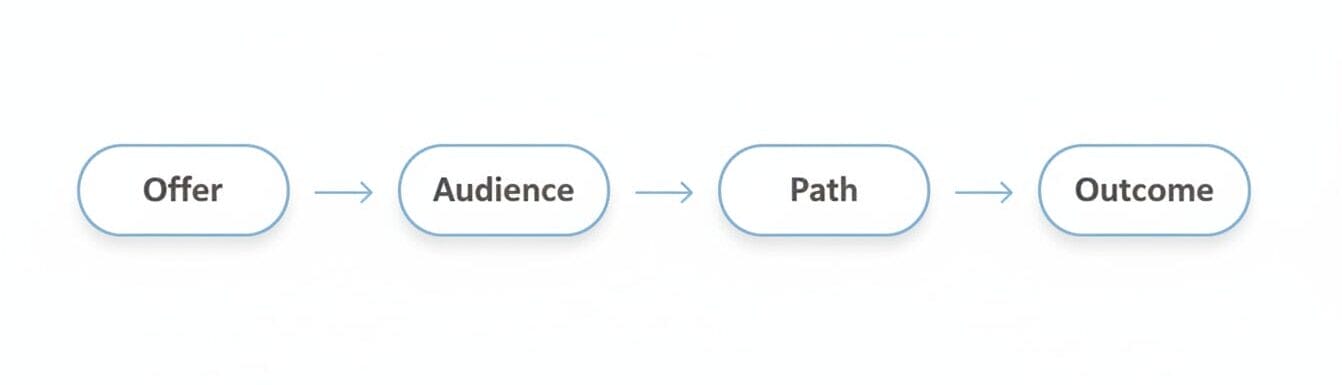
Real scale happens when:
- the offer is obvious
- the path forward is clear
- the decision is easy
- the operation doesn’t fight itself
Businesses don’t stall because they’re small. They stall because they’re cluttered.
Why Simple Businesses Win Over “Sophisticated” Ones
The market doesn’t reward complexity. It punishes confusion.
Customers don’t choose the most elaborate option. They choose the one they understand fastest.
They don’t want:
- your internal logic
- your org chart
- your proprietary framework
- your 40-page pitch deck
They want to know:
- Is this for me?
- Does it solve my problem?
- Can I trust it?
Simplicity answers those questions instantly. Complexity delays them — or kills the decision entirely.
Complexity Scales Headcount. Simplicity Scales Impact
Complex businesses grow by hiring more people to manage the mess. Simple businesses grow by making the mess unnecessary.
One scales payroll. The other scales results.
If your growth requires:
- constant oversight
- more approvals
- layers of management
- explanations for why things are “complicated”
You’re not scaling. You’re compensating.

The Businesses That Scale Fast Are Ruthlessly Clear
They:
- cut what doesn’t matter
- protect what does
- say no without apology
- refuse to confuse motion with progress
They don’t worship growth. They design for velocity.
Simplicity isn’t a constraint. It’s an accelerant.
And it will always outrun complexity — every time.